
What Counts as a Fever?
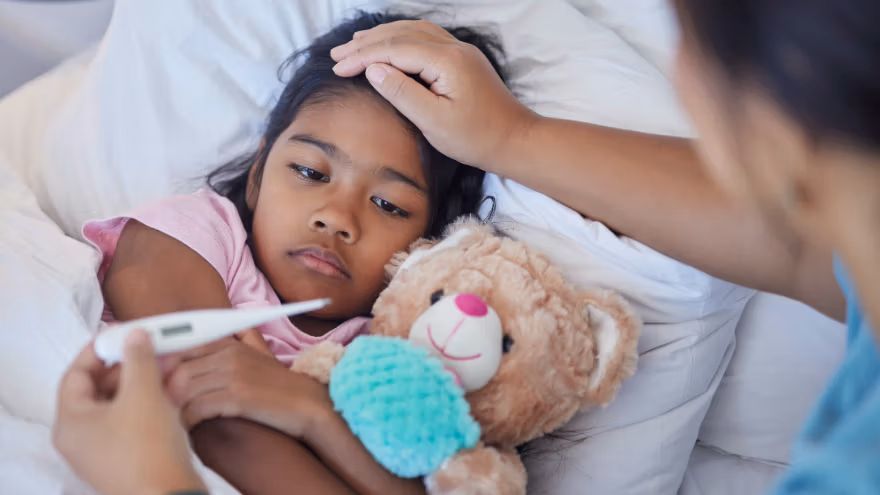
A temperature of 38 °C or higher is a fever. Touching your child's forehead is not a reliable way to tell. A simple digital thermometer, placed under the arm for young children, gives you a real number and helps the doctor too.
Fever is not an illness in itself. It is the body's way of fighting an infection, and most fevers in children are caused by common viral infections that clear up on their own within a few days.
In Rwanda, Always Test for Malaria
Any child with a fever in Rwanda should be tested for malaria promptly, ideally the same day. Your village community health worker can do a free rapid test. Malaria in young children can become dangerous quickly, and a negative test also helps the doctor look for the real cause.
Caring for Your Child at Home
- Offer plenty of fluids. Breastfed babies should be fed more often than usual.
- Dress your child in light clothing. Do not wrap them in blankets to 'sweat out' the fever.
- If your child is uncomfortable, you can give paracetamol at the dose for their age and weight shown on the packet.
- Never give aspirin to children.
- Do not use cold water baths or alcohol rubs. They make children shiver and can raise body temperature.
- Let your child rest, and check on them regularly through the night.
Go to a Health Facility Immediately If
- Your baby is younger than 3 months and has a temperature of 38 °C or higher
- Your baby is aged 3 to 6 months and has a temperature of 39 °C or higher
- Your child has a convulsion (fit)
- Your child is unusually sleepy, floppy or hard to wake
- Your child cannot drink, breastfeed, or keep anything down
- Breathing is fast, noisy or difficult
- A rash appears that does not fade when you press a clear glass against it
- Your child has a stiff neck or cries when their neck is moved
- There are signs of dehydration: dry mouth, no tears, sunken eyes or very few wet nappies
- The fever has lasted five days or more
What to Do During a Febrile Seizure
Some young children, usually between six months and five years, have a seizure when their temperature rises quickly. It is frightening to watch, but most febrile seizures stop within a few minutes and do not cause lasting harm.
- Lay your child on their side on a safe surface
- Do not put anything in their mouth
- Note the time the seizure started
- Call for emergency help if it lasts longer than five minutes
- Take your child to be seen by a doctor after any first seizure
Myths and Facts
- Myth: Teething causes high fever. Fact: Teething may cause a slightly raised temperature, but not a true fever. If your teething baby has a fever, look for another cause.
- Myth: Any fever can cause brain damage. Fact: Ordinary fevers from infections do not damage the brain. The danger comes from the illness causing the fever, which is why the warning signs matter.
- Myth: A fever must be brought down to normal. Fact: The goal is to keep your child comfortable, not to reach a perfect number.
- Myth: Antibiotics treat every fever. Fact: Most childhood fevers are caused by viruses, which antibiotics cannot treat. Use them only when a doctor prescribes them.
Pediatric Care at ClinicRW
Our Pediatrics team sees children with fever every day. We can test for malaria and other infections on site, examine your child thoroughly, and give you a clear plan for care at home or treatment at the clinic. If you are worried, trust your instinct and bring your child in.
Have questions or want to speak with a specialist?
Book a Consultation